
Acne Scar Guide
Types of Acne Scars and what treats each one
Most people have more than one type of acne scar, and each type responds to different treatments. Knowing your scar types is the first step to a plan that works.
Specialist consultations from $395 · No referral needed to book · Treatment costs confirmed in writing before you start · See fees
A dermatologist-led clinic, founded by Dr Mitch Robinson, FACD, who teaches laser to dermatologists and registrars and has fellowship training in complex scarring.
Meet Dr MitchAcne Scars at a Glance
Each illustration shows a cross-section of the skin.
Illustrations, not real patients.
Ice Pick Scars
Narrow, deep scars, usually under 2 mm across, that look like small punctures. They are hard to treat with laser alone because the energy can't reach the base.
Treated with: TCA CROSS or punch excision.
Boxcar Scars
Round or oval dips with sharp, steep edges, like a small crater. They can be shallow or deep.
Treated with: shallow ones with CO2 laser, erbium laser or RF microneedling. Deep ones with punch excision or elevation.
Rolling Scars
Broad, soft-edged dips that make the skin look wavy, especially in side lighting. Bands of scar tissue under the skin pull the surface down.
Treated with: subcision, sometimes with injectables, then resurfacing.
Raised Scars
Thick, firm scars that sit above the skin, more common on the jaw, chest, back and shoulders. Keloids grow beyond the original spot.
Treated with: injections, laser and other options. See keloid scar management.
Red and Brown Marks
Flat marks that aren't true scars. Red or pink marks come from small blood vessels. Brown marks are pigment left by inflammation, and are more common in darker skin.
Treated with: DermaV laser for red marks, and pico laser and skincare for brown marks.
How We Assess Your Scars
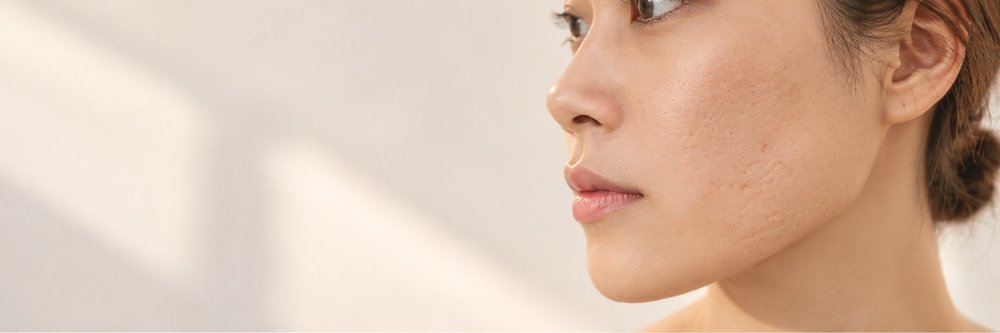
At your consultation we examine your skin under side lighting, which shows scar depth more clearly than overhead light, and gently stretch the skin to see whether scars are tethered. We take standardised photos so progress can be compared fairly.
We then plan the order of treatment, usually treating individual deep scars before resurfacing the whole area. See what results to expect and acne scar treatment.
Common Questions
Types of Acne Scars: Common Questions
How do I know what type of acne scar I have?
Look at your skin in side lighting from a window. Narrow pits are ice pick scars, steep-sided dips are boxcar scars and wavy dips are rolling scars. A dermatologist can confirm this at consultation.
Can you have more than one type of acne scar?
Yes. Most people have a mix, which is why most plans combine treatments.
Which acne scars are hardest to treat?
Deep ice pick scars and tethered rolling scars, because lasers alone can't reach or release them.
Are red marks scars?
No. Flat red marks come from blood vessels and usually fade. A scar changes the skin surface.
Do acne scars get worse with age?
They can look more obvious as the skin loses collagen with age, which is one reason some people choose to treat them.
Can acne scars be removed completely?
Rarely. Treatment can often make them much less noticeable, but complete removal of deep scars is uncommon.
Find Out What Will Work for Your Scars
Book a consultation with Dr Mitch. He'll name your scar types, explain what treatment can and can't do, and give you a written plan with the total cost before you decide.
← Back to Acne Scar Treatment · Send us photos first
Clinical content overseen by Dr Mitch Robinson, FACD (AHPRA MED0001946771). Updated October 2026. General information only, not medical advice. All procedures carry risks; suitability, recovery and results vary between individuals.