
Skin Cancer Surgery · Mount Gravatt, Brisbane
Skin Cancer Surgery in Mount Gravatt, Brisbane
Removal of basal cell carcinoma (BCC), squamous cell carcinoma (SCC), melanoma and lentigo maligna under local anaesthetic in our Mount Gravatt skin cancer clinic, with the repair planned for the site, by our specialist dermatologists.
Specialist consultations from $395 · Medicare rebates apply where eligible · Surgery quoted in writing after assessment · See fees
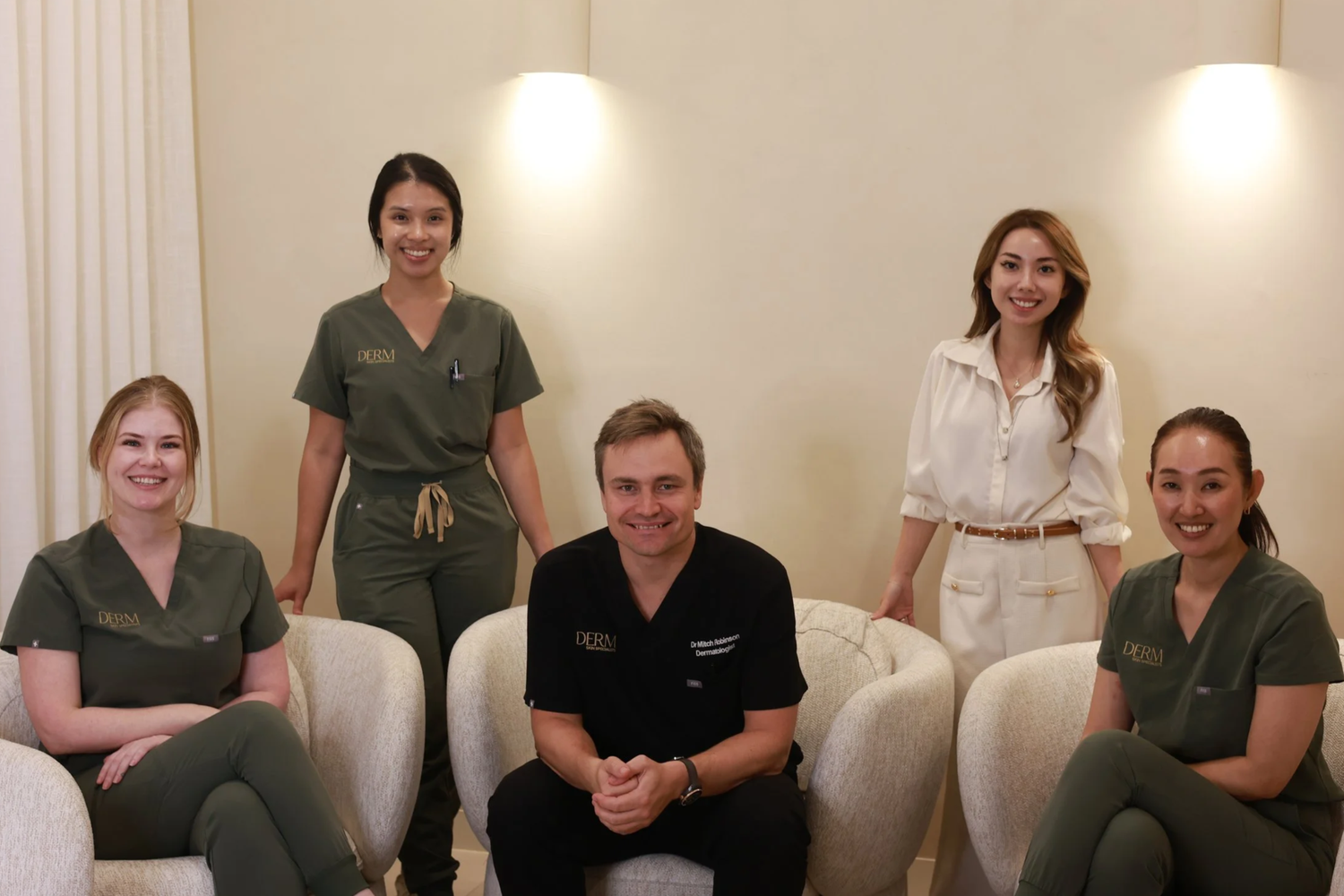
Skin cancer surgery by FACD specialist dermatologists. Dr Mitch Robinson was first author of Australia's clinical practice guidelines for lentigo maligna, and Dr Benny Yau was awarded the Kossard Prize in Dermatopathology.
Meet the TeamSkin Cancer Surgery at a Glance
Do I Need Surgery to Remove My Skin Cancer?
The short answer: for most basal cell carcinomas, squamous cell carcinomas and melanomas, cutting the cancer out is the most reliable treatment, because the whole cancer can then be checked under a microscope to confirm it has gone. Most skin cancer surgery is a short procedure under local anaesthetic in our rooms, and you go home the same day.
Surgery, also called excision, removes the cancer with a rim of normal-looking skin, called the margin. A pathologist then checks that the edges are clear. The wound is closed with stitches, or with a flap or graft when it can't be closed in a straight line.
Not every skin cancer needs a scalpel. Some superficial BCCs and early, surface-only SCCs suit photodynamic therapy or other non-surgical treatment, and we'll tell you when that's reasonable.
We see patients from Mount Gravatt and across Brisbane's southside, including Holland Park, Carindale and Sunnybank. If your GP says a spot needs removing, you can book with us directly.
See a doctor promptly if you notice
- A new or changing mole or spot
- A sore that won't heal
- A spot that bleeds or crusts again and again
- A pearly, scaly or tender lump that is growing
Worried about a fast-changing spot? Call 07 3487 1414 so we can find an earlier appointment.
How it works
Excision with a margin
Every operation takes the cancer with a margin of normal skin, as an eye shape that closes flat. Choose the cancer to see its margin.
- A BCC ready to be removed. The natural creases of your skin decide which way the cut will run.
- We mark a margin of normal-looking skin around the BCC, usually a few millimetres, so the whole cancer comes out.
- The cut is drawn as a narrow eye shape about three times longer than it is wide, lined up with your skin creases, so it closes flat.
- After numbing, the eye shape is removed through the full thickness of the skin and sent to the lab, which checks the edges are clear.
- Dissolving stitches underneath take the tension, and finer stitches close the surface in a straight line. They come out after about 5 to 7 days on the face, 10 to 14 on the body.
- An invasive SCC ready to be removed. Your skin creases decide which way the cut will run.
- We mark a margin of normal-looking skin, usually 3 to 5 mm for an invasive SCC, and wider for larger or higher-risk SCCs.
- An eye shape is drawn around the margin, about three times longer than it is wide and lined up with your skin creases, so the wound closes flat.
- After numbing, the skin is cut out through its full thickness. The lab checks the SCC and confirms the edges are clear.
- The wound is closed in a straight line: dissolving stitches underneath, finer stitches on the surface. Stitches come out after about 5 to 7 days on the face and 10 to 14 on the body.
- A raised spot that might be melanoma is removed whole, not sampled, so the pathologist can see all of it.
- An excision biopsy takes the spot with a 2 mm margin of normal skin, drawn as a small eye shape.
- The spot goes to the lab and the wound is closed with a few stitches. It’s done in our rooms under local anaesthetic and usually takes 20 to 30 minutes.
- The pathologist measures how deep the melanoma goes, its Breslow thickness. That sets the next margin. Results usually take about a week.
- The wide local excision margin is measured from the biopsy scar: 5 to 10 mm for melanoma in situ, 1 cm up to 1 mm thick, 1 to 2 cm from 1 to 4 mm, and 2 cm over 4 mm.
- The wider eye shape is removed for the lab, and the wound is closed in a line. On tight skin, such as the face, shins or scalp, it may need a flap or graft.
Simplified illustration, not to scale. Your margin and repair depend on the cancer and where it is.
Type, size and site
Which Skin Cancers Do We Remove?
The type of cancer, its size and where it sits decide the margin, the repair, and whether surgery is the first choice.
BCC and SCC
- Basal cell carcinoma (BCC). Australia's most common skin cancer: a pearly or pink lump, or a sore that bleeds and won't heal. BCCs rarely spread, but keep growing.
- Squamous cell carcinoma (SCC). A thick, scaly or tender lump that grows over weeks to months. SCCs can occasionally spread, so we treat them promptly.
- Bowen's disease. An early SCC in the top layer of skin. Often suits non-surgical treatment.
Melanoma and others
- Melanoma. A new or changing mole or spot, removed first with a narrow margin to confirm it, then with a wider one.
- Lentigo maligna. An early melanoma on sun-damaged facial skin that can look like a sun spot.
- Recurrent cancers. Cancers that have come back, or where earlier pathology showed cancer at the edge.
Cut out, checked, closed
Skin Cancer Removal in Brisbane: Excision, Flap or Graft?
Every operation removes the cancer with a margin. What differs is how the wound is closed, which depends on its size and the loose skin nearby.
How it works
Closing the wound: line, flap or graft
Once the cancer is out, how the wound is closed depends on its size and the loose skin nearby.
- Say removing the cancer and its margin leaves a round wound, with enough loose skin nearby to close it.
- Pulled straight together, a round wound would pucker at each end. So it’s lengthened into an eye shape about three times longer than it is wide.
- Dissolving stitches underneath take the tension, and finer stitches close the surface in a straight line, along your skin creases where possible.
- Stitches come out after about 5 to 7 days on the face, 10 to 14 on the body. The line looks pink at first, then flattens and fades over 12 to 18 months.
- On the nose, cheek, eyelid, lip or ear, a wound can be too large to close in a straight line without pulling things out of shape.
- The wound is squared off, and two cuts free up a flap of the skin next door. Its far end stays attached, so the flap keeps its blood supply.
- The flap is moved across to cover the wound, so the colour and texture match well.
- It’s stitched in place. The trade-off is a longer scar with angles, planned to sit along the natural lines of the face.
- Facial stitches come out after about 5 to 7 days. Allow more than 2 weeks before an event, and expect the lines to keep fading over 12 to 18 months.
- Some wounds have too little loose skin nearby for a flap, such as on the nose tip, ear, scalp or lower leg.
- We trace the wound’s shape and match it to a donor site, often near the ear, the neck or the collarbone.
- A piece of full-thickness skin is taken from the donor site, trimmed to fit, and the donor site is closed in a straight line.
- The graft is stitched over the wound, edge to edge.
- A firm dressing is tied over the graft and stays on for about a week while it takes.
- Grafts can look paler or shinier than the skin around them at first. Like any scar, they keep settling over 12 to 18 months.
Simplified illustration, not to scale. The repair is planned for your wound and its site.
Excision With Stitches
Used for: most BCCs, SCCs and melanomas, especially on the body, arms and legs.
After numbing, the cancer is cut out as a narrow eye shape about three times longer than it is wide, so the skin closes flat in a straight line, lined up with your skin creases where possible. Dissolving stitches underneath take the tension; finer stitches close the surface.
A BCC or SCC is usually removed with a margin of a few millimetres up to about 1 cm. Most procedures take 30 to 60 minutes.
Local Flap
Used for: wounds on the nose, cheeks, eyelids, lips, ears and temples that are too large to close in a straight line.
Nearby skin, still attached to its blood supply, is moved across to cover the wound, so colour and texture match well. The trade-off is a longer scar with angles, planned to sit along the natural lines of the face.
Skin Graft
Used for: larger wounds, or the scalp, ear, nose tip and lower leg, where there isn't enough loose skin for a flap.
A thin piece of skin, often from near the ear, the neck or the collarbone, is stitched over the wound under a firm dressing. Grafts can look paler or shinier than the skin around them at first.
Curette and Cautery
Used for: some small, superficial BCCs and Bowen's disease on the body. The cancer is scraped away and the base sealed with heat. No stitches; it usually leaves a small, flat, white scar.
How it works
How curette and cautery works
Scrape, seal, repeat. Quick, done under local anaesthetic, and no stitches.
- A small, superficial skin cancer on the body, such as a superficial BCC or Bowen’s disease.
- Local anaesthetic numbs the area first.
- A sharp, spoon-shaped instrument called a curette scrapes out the soft cancer tissue. The scrapings go to the lab.
- Heat seals the base of the wound.
- Scraping and sealing are usually repeated two or three times in the one visit.
- There are no stitches. The wound heals on its own and usually leaves a small, flat, white scar.
Simplified illustration, not to scale. It suits selected small, superficial cancers.
Mohs Surgery
Mohs surgery removes a cancer in thin layers, checking each under the microscope on the day. It is mainly used for poorly defined or recurrent cancers around the eyes, nose, lips and ears. We don't perform Mohs surgery at DERM Skin Specialists; when it is the better option, we refer you to a Mohs surgeon.
Flap or Graft: Which Will I Need?
Most people need neither. On the body and limbs, nearly all wounds can be closed with a straight line of stitches. Flaps and grafts mainly come up on the face, scalp, ears and lower legs.
When a straight-line closure would pull an eyelid, lip or nostril out of shape, a flap is often preferred, because matching skin from next door blends well. A graft suits wounds with too little spare skin nearby, or areas that need close watching for recurrence, such as the scalp.
We discuss the likely repair beforehand, but the final choice is sometimes made once the cancer is out. Very large wounds, or operations needing a general anaesthetic, are referred to a hospital-based surgeon.
What decides the repair
- The size of the wound after the margin is taken
- How much loose skin is nearby
- Whether closing it would pull a lip, eyelid or nostril
- Your skin type, and any history of raised scars
- Your health, smoking and blood-thinning medicines
Scars fade slowly
Will I Have a Scar After Skin Cancer Removal?
Yes. Any cut through the full thickness of the skin leaves a scar. The aim is a fine, flat, well-placed line that is hard to notice once it matures.
Scars often look pink and slightly raised for the first few months, then flatten and fade over 12 to 18 months. The line is usually longer than people expect, because a round wound has to be lengthened to close flat.
If a scar stays red, raised or uneven, we can refine it in the same clinic with vascular or CO2 laser, or with scar revision. Raised scars are more common on the chest, shoulders and upper back, and in people who have had keloids. More on raised scars.
What Happens at Your Skin Cancer Surgery?
From your first visit to your results, here's what to expect.
Your Skin Cancer Surgery Assessment
A dermatologist examines the spot with dermoscopy. If the diagnosis isn't clear, a small biopsy comes first. You get a written quote and a repair plan before surgery.
Surgery day
The area is marked and numbed. The cancer is removed, the wound closed and dressed, and you go home the same day with written wound care.
Results and review
Pathology usually takes about a week. We contact you with the result, take out your stitches and plan your future skin checks.
Does Skin Cancer Surgery Hurt?
The local anaesthetic injection stings for 10 to 20 seconds, then the area goes numb. After that most people feel pushing and tugging, but not sharp pain. If you feel anything sharp, tell us and we add more anaesthetic.
You stay awake and can talk throughout, and you go home the same day.
Once the numbing wears off, most people have a mild ache for 1 to 3 days. Simple over-the-counter pain relief is usually enough; we'll tell you which to use, because some can increase bleeding.
Bruising and swelling are common, especially around the eyes and forehead. Cold packs and sleeping with your head raised help.
Before surgery, tell us if you
- Take any blood-thinning medicine; don't stop it unless your doctor says so
- Have a pacemaker or implanted defibrillator
- Have had a reaction to local anaesthetic, dressings or tape
- Have diabetes, smoke or vape, which slow healing
- Have had keloids or raised scars
How Long Does Skin Cancer Surgery Take to Heal?
Most people go back to desk work the next day. Healing depends on the site:
- Face: stitches out after about 5 to 7 days; bruising settles in 1 to 2 weeks
- Scalp, neck, chest and arms: about 7 to 14 days
- Back, shoulders and lower legs: about 10 to 14 days; legs heal more slowly
- Skin grafts: a firm dressing stays on for about a week
Keep the dressing dry for the time we advise, usually 24 to 48 hours. Avoid heavy lifting, the gym and swimming until your stitches are out, as stretching can widen the scar. Protect the scar from the sun for at least a year.
Before an event. Allow at least 2 weeks after facial surgery, and longer for flaps or grafts. Talk to us before putting off treatment for an event.
When to Call Us After Skin Cancer Surgery
- Bleeding that doesn't stop after 20 minutes of firm pressure
- Increasing pain, redness, heat or swelling after the first 2 days
- Pus, a bad smell or a fever
- The wound opening up, or a graft lifting or turning dark
Call 07 3487 1414. Outside hours, see your GP or go to an emergency department.
Skin Cancer Surgery Risks, and How We Reduce Them
All procedures carry risks. Here are the main ones and what we do about each.
Common, Short-Term Side Effects of Skin Cancer Surgery
- Bruising and swelling. Expected, especially near the eyes. We plan surgery around your commitments where we can.
- Bleeding. Usually minor. We ask about blood thinners in advance and use a pressure dressing.
- Wound infection. In a Queensland general practice study, about 1 in 12 skin excisions became infected, more often on the legs, in people with diabetes, and after BCC or SCC removal (Heal et al., MJA 2006). We use sterile technique, give clear wound care and see you early if anything looks wrong.
Less Common Skin Cancer Surgery Risks
- A wide, raised or dark scar. More likely on the chest, back and shoulders and in olive or darker skin. We plan the scar line and treat problem scars early.
- The wound opening, or a graft or flap not taking. More likely with stretching too soon or smoking. We tell you what to pause and for how long.
- Cancer at the margin. Sometimes more surgery is needed. We explain your pathology and the next step.
If something doesn't heal as expected, you come back to us. Call the clinic and we'll see you here, rather than leaving you to sort it out elsewhere.
What If the Margins Aren't Clear?
Your pathology report confirms the type of cancer and whether there is a rim of normal skin all the way around it. Most cancers are fully removed the first time, but sometimes cancer cells reach the edge.
Skin cancers can extend further under the skin than they look, especially on the head and neck. A UK audit found head and neck site and recurrent cancers were the main risks for incomplete excision (Nolan et al., BJS 2022), though it covered one country during the pandemic.
If a margin is involved, we usually recommend removing a little more tissue through the same scar. Occasionally radiotherapy or a Mohs referral suits better. We'll explain why.
Your pathology, step by step
- The tissue is marked so each edge can be identified
- The pathologist confirms the type and measures the margins
- Results usually take about a week
- We contact you with the next step
Will My Skin Cancer Come Back?
Most fully removed skin cancers don't come back in the same place. A small number do, so any lump, sore or scaly patch in or beside an old scar needs to be seen.
The bigger issue is new skin cancers. People who have had one are more likely to develop another, and about two in three Australians are diagnosed with skin cancer by age 70 (Cancer Council Australia). Surgery is usually the start of regular checks, not the end of care, and we set a plan that suits your risk. More on skin cancer checks.
Guideline-led care
Melanoma and Lentigo Maligna Surgery
Melanoma excision
A suspected melanoma is usually first removed whole with a narrow margin, so the pathologist can confirm it and measure its thickness. A wider excision through the same area follows, with the margin set by that thickness under Australian guidelines. For thicker melanomas, we refer you promptly to a melanoma surgeon.
More on melanoma diagnosis, margins and follow-up.
Lentigo maligna
Lentigo maligna is an early melanoma in the top layer of skin, usually on the sun-damaged face. It looks like a flat, uneven brown patch that slowly spreads, and is easy to mistake for a sun spot.
Dr Mitch Robinson was first author of Australia's evidence-based guidelines for lentigo maligna, developed through Cancer Council Australia. They recommend surgery with 5 to 10 mm margins where possible, radiotherapy when surgery isn't suitable, and not freezing or laser (Robinson et al., Dermatology 2020).
It often extends further than it looks. In one study of head and neck lentigo maligna, 6 mm margins fully cleared about 61% and 9 mm about 72%, while staged removal, with edges checked before the final repair, had no recurrences over about two years (de Wet et al., JAAD International 2022). The study was from one centre with short follow-up. Facial lentigo maligna surgery may be planned in stages, and we'll explain how.
Can Skin Cancer Be Treated Without Surgery?
Sometimes. Treatment is chosen by diagnosis, so the first step is confirming exactly what the spot is, often with a biopsy.
Photodynamic therapy (PDT). For biopsy-proven Bowen's disease and selected superficial BCCs, a light-activated medicine is applied and then activated with light. It can avoid a surgical scar, but clears fewer cancers than surgery, so close follow-up matters. More on laser-assisted PDT.
Field treatment. For sun damage and sunspots (actinic keratoses) across an area, creams, PDT or laser treat the whole field. More on sun damage treatment.
Freezing, or curette and cautery. For selected small, superficial spots.
When surgery is the better choice. Thick, deep, fast-growing, recurrent or aggressive cancers, cancers with poorly defined edges, and all melanomas usually need surgery.
How Much Does Skin Cancer Surgery Cost With Medicare?
A specialist consultation starts from $395. Surgery is priced on assessment, because the cost depends on the type, size and site of the cancer and whether you need a straight-line closure, a flap or a graft. You get a written quote before you book the procedure. Pathology is billed separately by the laboratory.
Medicare. Skin cancer surgery is a medical procedure, so Medicare rebates apply where eligible. We're a private billing practice and don't bulk bill, so expect an out-of-pocket cost after your rebate. A valid GP referral is needed for a Medicare rebate on your consultation, but you can book without one.
Private health insurance. Hospital cover generally doesn't apply to procedures in our rooms. If you need surgery in hospital, we'll explain your options.
If a spot is harmless, or a non-surgical option suits it, we'll tell you. See our fees.
Your dermatologists
Who Performs Your Skin Cancer Surgery?
Specialist Dermatologists (FACD) · Mount Gravatt, Brisbane
Your surgery is done by one of our specialist dermatologists, who diagnose skin cancer every day. The doctor who operates plans the diagnosis, margin and repair, and scar care happens in the same clinic.
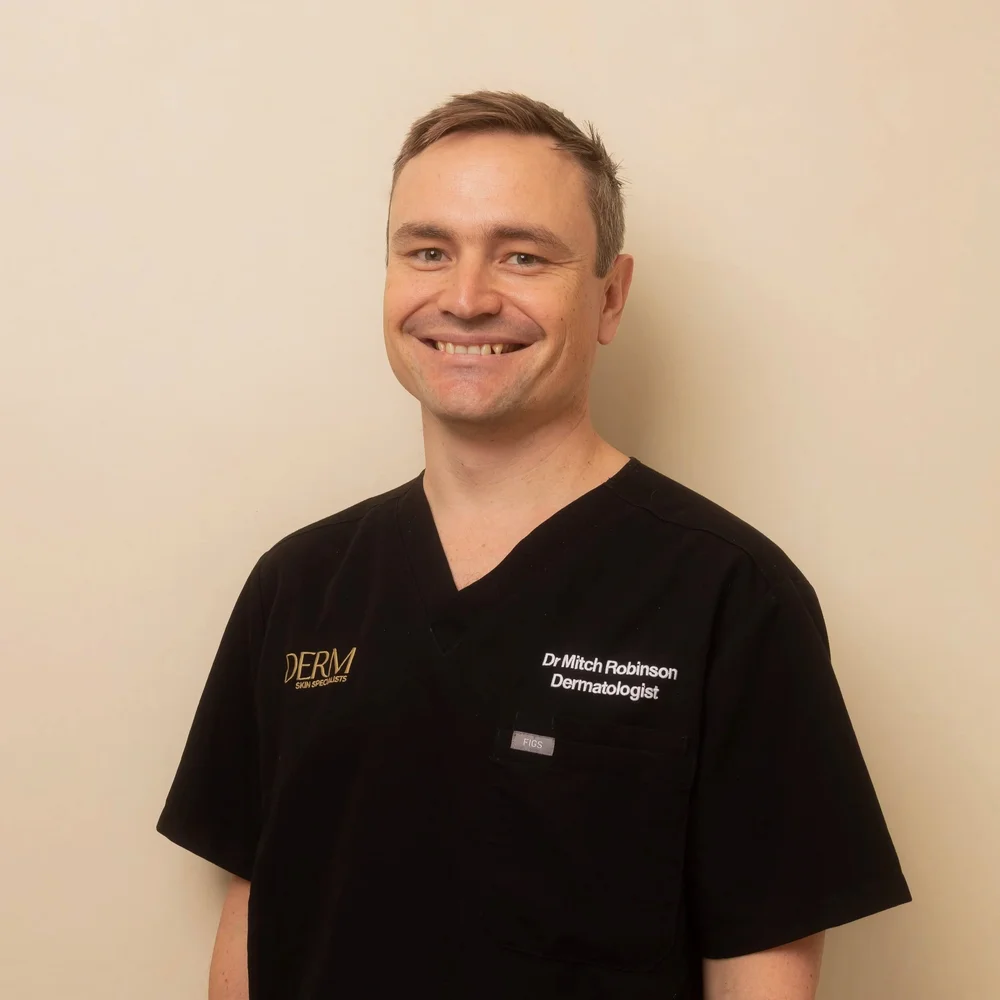
- Dr Mitch Robinson, FACDMaster's degree in skin cancer from The University of Queensland; first author of Australia's lentigo maligna guidelines; postgraduate training in dermatologic surgery
- Dr Benny Yau, FACD (AHPRA MED0000977637)Kossard Prize in Dermatopathology; worked in surgical specialties before dermatology and at the Peter MacCallum Cancer Centre
- Dr Emily Shao, FACD (AHPRA MED0002004352)Specialist dermatologist with a PhD and Master of Public Health; trained across Queensland's major hospitals
Mount Gravatt, Brisbane
Skin Cancer Surgery in Mount Gravatt
DERM Skin Specialists is a dermatologist-led skin cancer clinic at 2/1437 Logan Road, Mount Gravatt, about 15 minutes' drive from the Brisbane CBD, with free parking onsite. Patients come from across Brisbane's southside, including Mansfield, Wishart, Eight Mile Plains and Greenslopes.
Common Questions
Skin Cancer Surgery: Common Questions
How long does skin cancer surgery take?
Most excisions take 30 to 60 minutes, including numbing and dressing. Flaps and grafts take longer.
Will I be awake during the procedure?
Yes. It's done under local anaesthetic, so you're awake but the area is numb, and you go home the same day.
Can I drive home after skin cancer removal?
Usually, after a small procedure. Bring a driver if surgery is near your eye or you're having a larger flap or graft.
When do stitches come out?
About 5 to 7 days on the face and 10 to 14 days on the back and legs. Some stitches dissolve on their own.
Can I shower after skin cancer surgery?
Keep the dressing dry for 24 to 48 hours, or as advised. Then quick showers are fine; avoid baths, pools and the ocean until healed.
When can I exercise or swim again?
Once your stitches are out and the wound has closed. Stretching a healing wound can widen the scar.
How long until I get my results?
Usually about a week. We contact you with the result and whether anything more is needed.
Can my spot be removed at the first appointment?
Sometimes a biopsy or small removal is done on the day. Larger excisions, flaps and grafts are booked separately so we can plan and quote.
Is a BCC dangerous if I leave it?
BCCs rarely spread, but they keep growing and can damage nearby tissue, especially around the eyes, nose and ears. Smaller cancers mean smaller scars.
How big will my scar be?
Usually about three times the length of the wound, so it can lie flat. It fades over 12 to 18 months.
Can laser improve a scar after skin cancer surgery?
Yes, once healed. Vascular laser can fade redness and CO2 laser can smooth texture. Some scars suit scar revision instead.
Do you do Mohs surgery?
No. When Mohs is the better option, usually for poorly defined or recurrent cancers on the central face or ears, we refer you.
Should I stop my blood thinners before surgery?
Not unless your doctor says so, as stopping some can be risky. Tell us what you take when you book.
Is skin cancer surgery bulk billed?
No. We're a private billing practice. Medicare rebates apply where eligible, and you get a written quote first.
Do I need a referral?
No referral is needed to book. A valid GP referral is needed for a Medicare rebate on your specialist consultation.
Does private health insurance cover skin cancer removal?
Hospital cover generally doesn't apply to procedures in a specialist's rooms. It may help if you need surgery in hospital.
What happens if my melanoma is thick?
You'll need a wider excision, and we refer you promptly to a melanoma surgeon to discuss tests such as a sentinel lymph node biopsy.
How often will I need skin checks afterwards?
It depends on your risk: more often after a melanoma, and commonly yearly after a BCC or SCC. We'll set a schedule with you.
Have a Spot That Needs Attention?
Book a consultation with one of our specialist dermatologists. We'll confirm what the spot is, explain your options, including when surgery isn't needed, and quote in writing before any procedure.
Clinical content overseen by Dr Mitch Robinson, FACD (AHPRA MED0001946771). Updated October 2026. General information only, not medical advice. All procedures carry risks; suitability, recovery and results vary between individuals.